Operational in India for higher education, the name that we can not afford to ignore is UGC (University Grants Commission). So, if you are applying for your college, getting ready for government exams, or studying abroad, you must have heard the term UGC approved. However, there are still many students who do not understand clearly about what is UGC Act, and Why is it so important.
To put it simply, from the legal perspective, the UGC Act is the framework and base that governs and regulates universities in India. It keeps your degrees, real, recognized and valuable. This guide is going to give you everything in a straightforward manner so that you completely get what it means for your academic career as an Indian student or parent reading this article, all that you need to know about the UGC Act.
What is UGC Act?
The UGC Act is making reference to the University Grants Commission Act, which the Parliament of India passed in 1956. The University Grants Commission(UGC) was formed as a statutory in the 01st December 1956 by this act.
It mainly aimed at coordinating, determining, and maintaining the standards of university education in India. A strong central administration to oversee universities was lacking before this law. With the growing number of institutions post-independence, it became essential for the government to step in and control the quality and stops the exploitation.
So UGC Act means in simple words UGC Act is a law from which the UGC comes into power for regulating higher education institutions in India.
Read Also: PM Matru Vandana Yojana
Why Was the UGC Act Introduced?

The Indian education system expanded rapidly after India gained independence in 1947. So many universities were created, and there was no quality control or coherent structure. While few had proper infrastructure and well-educated faculty, others were running only by name.
The government felt the need for:
- A measure of university education
- Financial support to genuine universities
- Regulation to stop fake institutions
- To align the central and state universities
In order to remedy these grievances, the UGC Act was passed in 1956. It not only sought to have control over universities but also aimed to strengthen the higher education sector.
Objectives of the UGC Act
The UGC Act has been enacted to serve a number of crucial objectives. It serves primarily to keep the universities accountable to uniform standards of teaching and research. It guarantees that students in India get the same quality of education irrespective they study in a central university, state university or private university.
Financial support is also a big key aim. The UGC provides grants to universities and colleges for development, research projects, infrastructure, and faculty development programs.
The Act also does well in ensuring a proper coordination between various universities. Education in India is a subject in the Concurrent List and coordination between the Centre and the states is of prime importance.
Above all, the Act protects students against any misleading organizations by authorizing only the validated universities to issue genuine degrees.
Powers of UGC Under the UGC Act
The University Grants Commission (UGC) has been empowered by the UGC Act. Such power is crucial for maintaining quality and discipline in higher education.
There is a powerful strength in recognition. UGC is an authority that can bestow valid recognition for the required standards of the universities. An institution cannot confer degrees without UGC recognition.
The UGC can periodically inspect those universities and colleges as well. The Commission may raise alerts or refrain from recognition if any establishment does not conform to criteria.
A further significant power is the regulation of degrees. Under the Act, degrees can be granted only by universities and institutions recognized under different provisions of the Act.
It also sets minimum standards for teachers and other academic staff. This guarantees that individuals are taught by appropriately qualified specialists.
Read Also: Railway Group D Vacancy 2025-26
Types of Universities Recognized Under UGC Act
Different types of universities are recognised under the UGC Act in India.
Central Universities have been established through an act of Parliament. Perhaps the central universities funded and governed by the central government, such as the University of Delhi and the Banaras Hindu University, are specific examples of this.
Among these, the first are the State Universities, which are simply institutions of higher education that were established by State Legislatures, and they are located in the state.
Institutions of high standing that are granted special status by the central government on the recommendations of the UGC. Private Universities are privately managed, but they are established with a State Act. Still, they have to follow UGC guidelines to function legally on the ground.
And all these universities are required to abide by UGC’s regulations for them to be able to retain their recognition.
Why is the UGC Act Important for Students?
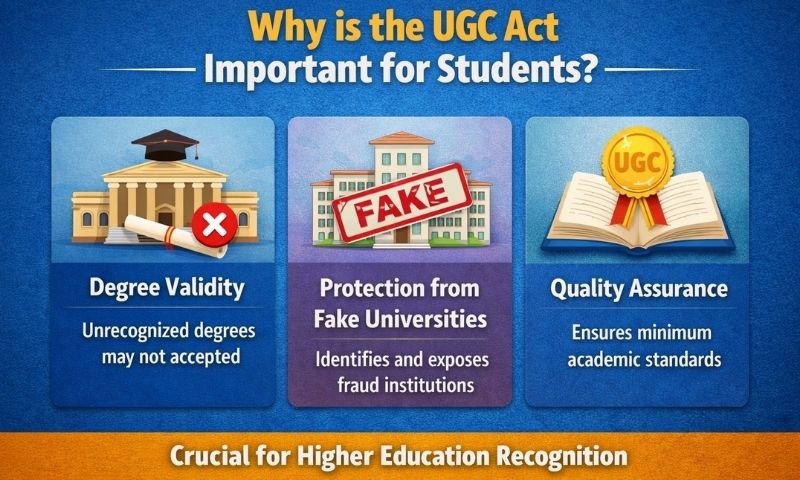
This Act has massive significance for the Indian students as it directly impacts the degree validity for them.
In case you are studying in a non-UGC-recognized university, then your degree will not be valid for admission to any government jobs, higher education at a different institute, or employment in the private sector. A number of students faced issues in getting admission in the campuses without confirmation of UGC approval.
The UGC Act also ensure that students get proper quality education. It provides academic oversight by ensuring that institutions meet minimum standards for faculty qualifications, curriculum, and infrastructure.
Finally, the Act also assists in enhancing the credibility of the Act internationally. Foreign universities and employers check if the Indian degree is from UGC recognised institution.
Read Also: Jharkhand Mukhyamantri Maiya Samman Yojana
UGC Act and Fake Universities
One of the key things that the UGC Act does is prevent fake universities. UGC publishes the fake institutions working in the country every year.
Such bogus institutions use different things and means to lure students, including quick degrees, low fees, or job guarantees. But those degrees do not count legally.
In fact, these institutions will not be able to take legal action under the UGC Act. It is always advised for students to check whether a university is recognised before they take admission.
UGC Act and Technical Education
There are many students who mix up UGC with AICTE. UGC regulates general higher education, and technical and professional courses are regulated by the All India Council for Technical Education (AICTE).
Apart from UGC recognition, AICTE approval is also needed for engineering, MBA, pharmacy, and technical diploma courses. Both bodies strive to maintain required standards for professional education.
UGC Act and Distance Education
In the times of online and distance learning, the UGC Act simply makes sense. Valid distance or online degree programs can only be conducted by universities that are approved by the UGC.
A UGC recognised degree ensures that the degree of the online university too is recognised for jobs and further studies. Students also need to be cautious during their enrollment in the online programs and query for their official acknowledgment.
UGC Act and Education Reforms
For the last few years, we have been seeing different reforms to change the education system in India, such as the National Education Policy 2020. Even as higher education regulation has been quietly rethought, the UGC Act remains in the middle of it all.
The underlying purpose of policy reforms to sustain setting standards will not change.
How to Check UGC Recognition?

Students can check for UGC recognition from the official UGC website. There is a list of recognised universities divided into categories on the website. Wherever you are taking admission, check if the university is under Section 2(f) and 12B or not; it is a very easy way to not get into trouble afterward.
Conclusion
It is not merely a legal definition as to what the UGC act is that you understand!!! It will secure your future well-being. Universities were required by both state and central legislation to maintain standards and provide quality education. Under the UGC Act, legal degrees were to be issued to students.
Checking UGC recognition needs to be the first step by Indian students and parents, prior to taking admission anywhere. A relevant degree becomes your ticket to a government job, to pursue higher studies, and to foreign job opportunities.
In more layman’s terms, the UGC Act forms the backbone of the higher education system in India. It protects students, preserves academic integrity, and promotes a reliable and transparent education system.
Never underestimate a UGC approval while you are mapping your academic path. Your degree is an investment in your future, and this is where the UGC Act guarantees the quality of your degree and makes sure your investment is secure.